NFT Price Floor
A modernization of an NFT analytics and marketplace platform, focused on design systems, clearer market data surfaces, editorial sections, drops, and direct NFT purchase flows.
- Role
- Lead Frontend Engineer & Design Engineer
- Year
- Jan 2023 — Jun 2024
- Company
- NFT Price Floor
- Status
- Shipped
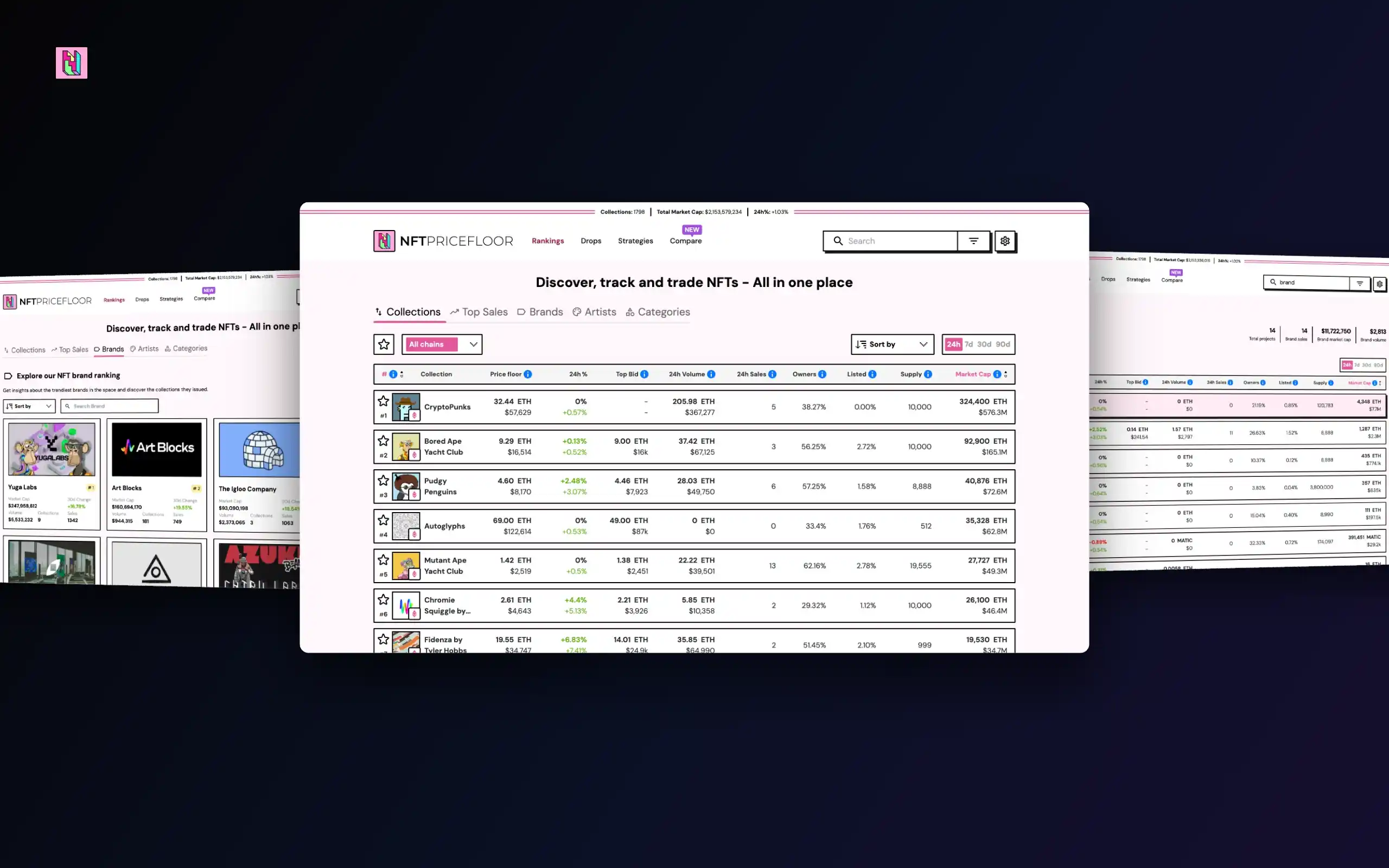
NFT Price Floor is an NFT analytics and marketplace platform focused on helping users understand collection prices, market activity, sales, drops, and trading opportunities across the NFT ecosystem.
I joined as the main frontend owner during a period where the product needed to become more consistent, more usable, and easier to extend. My work focused on modernizing the user interface, creating the company's Design System, improving frontend maintainability, and leading the implementation of new user-facing product sections such as Top Sales, News, Drops, and direct NFT purchase flows.
This project sits at the intersection of market data, Web3 product UX, editorial discovery, and marketplace interaction. It gave me the opportunity to work not only as a frontend engineer, but also as a design partner shaping the visual and interaction language of a live platform.
Why this project matters
NFT products have a difficult UX challenge: they need to serve users who are browsing visually, comparing prices, reading market signals, discovering collections, and sometimes making high-intent purchase decisions.
A platform like NFT Price Floor cannot be only a spreadsheet of collection prices. It needs to help users quickly understand what is moving, what is worth exploring, and what action they can take next.
When I joined, the product needed a stronger frontend foundation and a more consistent design language. New sections were being added, but the experience had to feel like a coherent platform rather than a collection of independent pages.
My role was to help move the product toward a more scalable frontend and design foundation while delivering visible product features that improved discovery, usability, and marketplace interaction.
My role
I joined NFT Price Floor as the main frontend owner and later worked as Lead Frontend Engineer & Design Engineer.
My work included:
- Helping build the frontend team and establish stronger frontend practices.
- Creating and evolving the company's Design System.
- Modernizing the platform UI across key product surfaces.
- Leading the implementation of new product sections, including Top Sales, News, and Drops.
- Contributing to direct NFT purchase flows inside the platform.
- Translating product and design requirements into production-ready interfaces.
- Collaborating closely with product, design, and backend teams.
- Improving UI consistency, usability, and frontend maintainability.
- Working across React, Next.js, TypeScript, REST APIs, Node.js, Express.js, TurboRepo, and Figma.
The work required both execution and product judgment: I had to ship features while helping define the reusable patterns that would make future features easier to build.
Product problem
NFT Price Floor had to present a large amount of market information in a way that was fast to scan, visually clear, and useful for different user intents.
Some users arrive to compare collections. Others want to see recent high-value sales. Others are looking for upcoming drops, market news, or direct buying opportunities.
That created several frontend and design challenges:
- Market data needed to be readable at a glance.
- New sections had to feel connected to the rest of the platform.
- UI patterns needed to be reusable instead of one-off per page.
- The product had to support both analytics and marketplace behavior.
- Visual polish mattered because NFT users often judge trust and quality through interface craft.
- The frontend had to remain maintainable while the product expanded.
The core challenge was not only building pages. It was building a stronger product surface where data, discovery, and action could coexist.
Approach
I approached the work from two directions: product delivery and frontend foundation.
On the product side, I focused on shipping visible user-facing improvements. Sections like Top Sales, News, and Drops helped broaden the platform beyond static collection rankings and gave users more reasons to explore the product.
On the foundation side, I worked on the Design System and UI modernization. The goal was to make the product easier to scale by giving the team shared visual rules, reusable components, clearer spacing systems, and more consistent interaction patterns.
This combination mattered because new NFT product surfaces often share common needs: cards, rankings, collection previews, metadata, charts or data summaries, CTA areas, loading states, empty states, and responsive layouts. By standardizing those pieces, the product could move faster without losing visual consistency.
I also worked closely with backend and product teams to connect interfaces to real platform data and marketplace behavior, making sure the frontend matched both the business requirements and the technical constraints behind each feature.
Selected contributions
Design System creation
I created the company's Design System to bring consistency to a product that needed to support multiple types of content: collection rankings, market data, sales, drops, editorial content, and purchase-oriented surfaces.
The Design System helped define reusable patterns for typography, spacing, cards, buttons, sections, data presentation, and responsive behavior.
For a marketplace and analytics product, this was especially important because users need to compare information quickly. Consistency reduces friction: similar information should look similar, actions should be predictable, and important data should not compete with decorative UI.
Platform UI modernization
I worked on modernizing the platform UI so the product felt more polished, more cohesive, and more trustworthy.
The modernization work focused on improving visual hierarchy, making key information easier to scan, refining component behavior, and reducing inconsistency across different areas of the product.
This kind of work is often invisible when done well, but it changes how a product feels: pages become easier to understand, components feel more intentional, and new features can be introduced without visually breaking the experience.
Top Sales
I led the implementation of the Top Sales section, a surface focused on highlighting high-value NFT transactions and market activity.
The challenge was to make sales data useful without overwhelming the user. A good Top Sales view needs to show value, collection context, asset identity, timing, and relative importance in a compact and scannable way.
This section helped users understand what was happening in the market beyond collection floor prices. It added a more dynamic view of NFT activity and made the platform stronger as a discovery and analytics destination.
News
I implemented the News section to connect editorial content with market discovery.
For NFT platforms, news and data reinforce each other. Market movements often make more sense when users can also understand the context around collections, trends, launches, and ecosystem updates.
The News experience required a different UX rhythm than pure data tables. It needed readable content cards, clear hierarchy, responsive layouts, and a visual treatment that felt connected to the rest of the product without copying the same patterns used for rankings or sales.
Drops
I led the implementation of the Drops section, focused on upcoming NFT launches and collection discovery.
Drops are a high-intent part of NFT browsing. Users want to know what is coming, what looks interesting, and what they might want to track or act on.
The work involved creating a discovery-oriented surface that could present launch information, collection identity, timing, and visual assets in a format that felt engaging but still structured.
Direct NFT purchases
I contributed to flows that enabled NFT purchases directly on the platform.
This work extended NFT Price Floor from an analytics and discovery surface toward a more transactional experience. That created a higher bar for clarity, feedback, and trust because users need to understand the object they are buying, the action they are taking, and the state of the transaction.
Even when purchase flows are backed by existing marketplace infrastructure, the frontend needs to make the user journey feel safe and legible.
Frontend maintainability
Beyond individual features, I worked to improve maintainability across the frontend codebase.
That included creating reusable UI patterns, reducing duplicated interface logic, aligning implementation with design decisions, and helping the frontend team work with a more consistent product foundation.
This mattered because NFT products tend to evolve quickly. A maintainable frontend lets the team respond to new product ideas without turning every new section into a custom implementation.
Outcome
The work helped NFT Price Floor evolve from a data-heavy NFT platform into a more complete product experience with stronger discovery, editorial, marketplace, and design-system foundations.
Key outcomes included:
- A company Design System that improved consistency across the product.
- A modernized UI across important platform areas.
- Shipped user-facing sections including Top Sales, News, and Drops.
- Direct NFT purchase flows integrated into the platform experience.
- Improved frontend maintainability through reusable patterns and stronger implementation practices.
- A stronger collaboration model between product, design, frontend, and backend.
I am intentionally not including private metrics or internal business numbers here. The public value of the project is visible in the product scope, shipped surfaces, design-system work, and frontend ownership.